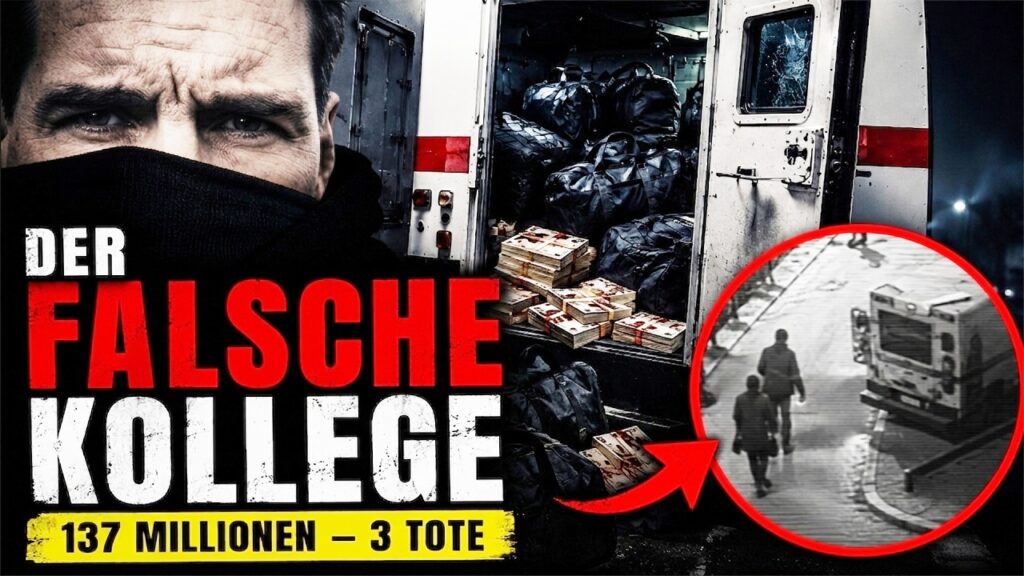
On the night of June 27, 2010, one of the most shocking cash robberies in modern Russian history unfolded on a busy road in Moscow. A heavily guarded vehicle carrying millions of rubles was found near the Third Ring Road, its engine still running and its doors locked. Inside were three dead employees. The sealed cash bags were gone.
A robbery that began with an open door
The armored vehicle had been transporting a large commercial cash collection when contact with its crew suddenly stopped. A satellite tracking device led investigators to the abandoned vehicle near the exit toward Shmitovsky Prospekt. The victims were driver Viktor Erokhin, security guard Oleg Khoseinov, and Anton Kovalyov, an employee of a contracted security company. Each had been shot in the head.
The attackers took 154 bags containing roughly 131 million rubles, leaving about six million behind. The scale of the theft initially suggested a highly organized criminal gang. Yet the scene revealed an even more disturbing fact: the robbers had not forced their way into the armored compartment. The crew had opened the door themselves.
That detail changed the investigation. Whoever planned the attack understood the company’s routines and had earned the victims’ confidence. The crime depended less on overpowering the vehicle than on making the intruders appear familiar.
The insider who knew the system
Maxim Podgornich worked as a cash-in-transit employee. He knew the routes, shift patterns, security procedures, and practical weaknesses that were invisible to outsiders. Colleagues regarded him as quiet and disciplined, while managers trusted him with valuable consignments.
The plan did not begin as a carefully developed criminal project. According to the investigation, the idea was first mentioned during a birthday gathering attended by longtime acquaintances from Orekhovo-Zuyevo. A joking remark about robbing a cash vehicle became serious after Alexander Mikhailov, known as “the Red,” repeatedly returned to it and persuaded Podgornich that it could be done.
Sergei Levkin, another employee connected to both men, was brought into the conspiracy. Mikhailov financed preparations, including weapons, telephones, and SIM cards reserved for planning the robbery. The group spent weeks driving the intended route at night, studying traffic, stops, and the timing of the vehicle’s movements.
Turning workplace familiarity into an ambush
The central weakness was a rule that existed on paper but was not always followed in practice. Employees occasionally gave colleagues a lift after a shift. People who had worked together for years did not necessarily question a familiar face asking for a ride.
Several days before the robbery, Podgornich arranged for Erokhin to pick him up at around three in the morning on Elektrolitny Prospekt. He then presented Mikhailov as a new company employee. Nothing about the request appeared unusual to the driver, who had transported colleagues before.
The vehicle continued along its normal route. Near Shmitovsky Prospekt, the two passengers drew their weapons. Khoseinov tried to reach his service pistol, but Mikhailov struck him with the weapon. Podgornich then seized the gun. The three employees were ultimately killed so there would be no surviving witnesses.
While the murders took place, Levkin waited nearby in a Nissan. The cash bags were moved into larger containers, and the group left within minutes. Traffic continued to flow along the ring road as the robbery unfolded almost unnoticed beside it.
Following the money
Investigators quickly concluded that an outsider could not have carried out the operation so efficiently. They examined whether one of the victims might have been involved, but found no evidence supporting that theory. Attention shifted to current and former employees with access to the company’s internal procedures.
Authorities analyzed the telephone activity of more than 5,000 subscribers, examining calls connected to the company, the route, and the crime scene. Podgornich’s name appeared repeatedly. At the same time, the conspirators’ spending began to expose them.
People who had recently lived on ordinary salaries suddenly bought expensive goods, traveled, or discussed major business ventures. Alexander Borisov, a traffic police officer suspected of helping the group move safely after the robbery, bought a house outside the city. Alexander Strekerov purchased a BMW X5, crashed it the next day, and still continued an expensive holiday. Levkin reportedly offered an acquaintance money to open a nightclub and arrived with ten million rubles in cash.
Podgornich retained about 60 million rubles. He bought an apartment in Krasnodar, spent heavily in nightclubs, and used roughly 1.5 million rubles during less than two weeks at the coast. Such displays made it increasingly difficult for the participants to remain invisible.
A conspiracy surrounded by danger
The stolen money created another threat: too many people knew where it came from. Weeks after the robbery, Pavel Tolstov and Ivan Kukolyov were killed. Both had connections to the gathering where the robbery had first been discussed. Tolstov was found in a swamp with hacking injuries, while Kukolyov had been shot.
The murders were not officially resolved as part of the armored-vehicle case, but investigators considered whether the men had known too much or attempted to blackmail the conspirators. Meanwhile, investigators recovered portions of the stolen cash from a safe-deposit box, vehicles, garages, and metal containers buried on properties. Much of the money, however, had already been spent.
Arrests and sentences
The first arrests began in July 2010. Five members of the group were captured within a month. Podgornich remained at large until March 2011, when investigators found him hiding with his family in Krasnodar. He had purchased an apartment and continued spending money, apparently convinced that he had escaped prosecution.
After his arrest, Podgornich quickly cooperated and gave detailed statements. In October 2012, a Moscow court sentenced him to 23 years in a strict-regime penal colony. Levkin received 20 years, while Mikhailov was sentenced to 19 years. Other participants received shorter prison terms or fines, including Strekerov, Vorotov, and Borisov.
The court ordered the convicted participants to repay approximately 130 million rubles. Podgornich was also ordered to pay compensation to the victims’ families, as was Levkin. None of the principal organizers received a life sentence; cooperation with investigators and the presence of minor children were considered mitigating factors.
The cost of misplaced trust
The robbery was remarkable not simply because of the amount stolen or the speed of the operation. Its defining feature was the way a security system was defeated from within. The attackers did not need to break through armor, stop traffic, or overpower an entire crew from the outside. They used professional familiarity as a key.
Every organization relies on procedures, but procedures are only as strong as the habits surrounding them. In this case, an exception that seemed harmless—letting a colleague ride in the vehicle—became the opening for a planned ambush. The people best positioned to protect the cash were betrayed by someone who understood exactly how their trust worked.
A detail we should revisit?
Send a correction or attribution concern with the article URL and supporting evidence.
Contact SwiftLocale ↗