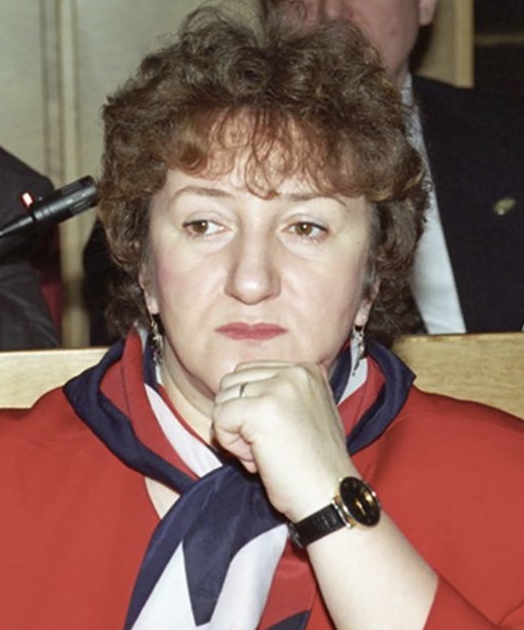
On the night of November 20, 1998, Galina Starovoitova returned to St. Petersburg after a trip to Moscow. She and her assistant, Ruslan Linkov, entered the stairwell of her apartment building beside the Griboyedov Canal. Two men were waiting.
One attacker was disguised in a wig and a woman’s coat. He carried a Czech Agram 2000 submachine gun fitted with a suppressor. His accomplice stood by with a pistol. The first weapon jammed after firing only one round. Linkov threw himself at the attackers, and the second gunman opened fire at close range. Starovoitova was struck in the head and neck and died at the scene. Linkov survived with serious injuries.
The killing was not simply the murder of a sitting legislator. Starovoitova was one of the best-known democratic politicians and human-rights advocates in post-Soviet Russia. She had helped shape the country’s early democratic movement, advised President Boris Yeltsin, and spoken publicly about corruption and the growing influence of former Soviet security officials.
A scientist drawn into politics
Born in 1946 in the Urals, Starovoitova trained as a social psychologist and completed a doctorate at the Institute of Ethnography of the Soviet Academy of Sciences. Her research focused on relations among the peoples of the Soviet Union. As national conflicts erupted in the Caucasus and the Baltic states during the final years of the USSR, that academic subject became an urgent political question.
Starovoitova entered public life as an adviser and political advocate. In 1989 she was elected a People’s Deputy of the Soviet Union and later served in the Supreme Soviet of the Russian Soviet Federative Socialist Republic. She belonged to the small democratic camp that did more than witness the Soviet collapse: its members helped drive the transformation.
After the failed coup attempt of 1991, she became Yeltsin’s adviser on interethnic relations. She was never a compliant presence inside the presidential administration. In 1992 she introduced legislation that would have restricted former full-time Communist Party officials and Soviet intelligence officers from holding certain state positions. The proposal failed, but her demand for a break with the old power structures remained central to her politics.
She went on to help found and co-chair Democratic Russia, the leading reform movement of the early 1990s, and entered the State Duma in 1995. Abroad, she was respected for her work with democratic and human-rights organizations, including the Moscow Helsinki Group and the National Endowment for Democracy. To supporters, those relationships reflected her commitment to open government. To security-minded critics, they were evidence of unacceptable Western influence.
An uncompromising public figure
Friends and colleagues remembered Starovoitova as unusually direct. She was said to challenge teachers as a schoolgirl when she believed they were wrong, and to search through multiple libraries for evidence supporting her arguments. That determination followed her into national politics.
In 1990 she tried to become the first woman to run for Russia’s presidency, but the Central Election Commission refused to register her. She openly criticized the rising influence of former KGB structures, warned against extreme nationalism, and demanded stronger protections for minorities and democratic institutions.
By 1998, her attention had turned increasingly toward the relationship between organized crime and St. Petersburg’s political establishment. The city was widely regarded as a center of the Tambov criminal organization, which had influence across port operations, energy trading, and municipal politics. Starovoitova was preparing to run for governor in December and appeared to have a credible chance.
Shortly before her death, she made unusually explicit allegations. She said she knew the names of local politicians who accepted bribes from organized crime and claimed that a seat in the city legislature had been sold directly to a criminal group. In a political environment where contract killings were common, such statements threatened identifiable interests.
The investigation and the first convictions
The ambush bore the marks of a planned operation. The killers had studied Starovoitova’s routines, travel arrangements, return times, and the layout of the stairwell. They knew when she would arrive from Moscow. The preparation suggested surveillance and coordination rather than a spontaneous act of violence.
The news provoked mourning across Russia. In St. Petersburg, long lines formed as people came to pay their respects. Former prime ministers spoke at her funeral, and memorial events were held abroad. President Yeltsin later described her as a standard of decency, humanism, and loyalty to shared democratic ideals.
The case moved slowly. Investigators questioned more than a thousand witnesses and pursued hundreds of investigative measures. In 2002, six suspects were arrested. A confession by one defendant eventually helped prosecutors assemble a partial account of the operation.
Yuri Kolchin, a former officer associated with Russian military intelligence, was identified as the organizer. Vitaly Akishin was identified as one of the immediate shooters. In 2005, nearly seven years after the murder, a St. Petersburg court sentenced Kolchin to 20 years in prison and Akishin to 23 years and six months in a high-security penal colony. Oleg Fyodorov, the disguised gunman, initially remained at large. Other participants were convicted, acquitted, or released from the case because the statute of limitations had expired.
The convictions established who had helped arrange and carry out the attack, but they did not establish who had paid for it. That gap is common in organized contract killings: layers of intermediaries can separate the person who orders a murder from the people who execute it, leaving prosecutors with proof of the crime but not the complete chain of responsibility.
The alleged link to the Tambov underworld
A possible breakthrough came in 2015, when former Duma deputy Mikhail Glushchenko reached an agreement with investigators. In exchange for a reduced sentence, he admitted involvement and named Vladimir Barsukov, also known by his former name Vladimir Kumarin.
Barsukov was regarded as one of the most powerful figures associated with the Tambov criminal organization. His influence was so extensive that St. Petersburg media sometimes referred to him unofficially as the city’s “night governor.” According to Glushchenko’s account, Barsukov ordered Starovoitova’s murder because her public statements about political corruption endangered his business interests and connections.
Barsukov was already serving lengthy sentences for other offenses. He was sentenced in 2009 for attempted murder of a businessman and in 2019 received an additional sentence for organizing a criminal association. In 2019, his lawyer said that Barsukov was also officially being investigated in connection with Starovoitova’s assassination.
He has denied the accusation. The allegation has not produced a final, legally binding judgment on his responsibility for the murder. As a result, the organized-crime explanation remains a serious investigative theory rather than a conclusive judicial finding.
The unresolved security-service theory
A second theory is politically more explosive. Human-rights activist and politician Valeria Novodvorskaya argued that the order may have come not from criminal groups but from within Russia’s security establishment.
Starovoitova had publicly opposed the proposed appointment of former security chief Yevgeny Primakov as prime minister. That opposition placed her in conflict with powerful figures connected to the post-Soviet security apparatus. Supporters of the security-service theory have also pointed to reports that she was accompanied on the evening of her death by a senior FSB general, the head of Russia’s domestic intelligence service and institutional successor to the KGB. They interpret that detail as a possible sign that some people in security circles knew in advance that she was in danger.
There is no court-confirmed evidence proving this theory. It persists because Starovoitova’s political work brought her into direct conflict with several overlapping systems of power: criminal networks, local officials, and former Soviet security institutions. In the Russia of the 1990s, those boundaries were often difficult to draw.
A legacy larger than the case
Starovoitova understood that her work carried risks. Colleagues said she repeatedly declined personal protection even after being encouraged to strengthen her security. Whether that decision reflected principle, habit, or a refusal to retreat from public life, it became part of the tragedy surrounding her death.
International organizations reacted quickly. Amnesty International issued a statement the day after the assassination. The Inter-Parliamentary Union followed the case for years through its committee on the human rights of parliamentarians, warning that unresolved political murders can intimidate other lawmakers and critical voices. The Journal of Democracy published a substantial tribute to her role in the post-Soviet democratic movement.
In St. Petersburg, her sister Olga later established a foundation and museum in her memory. Annual Starovoitova Lectures bring scholars and human-rights advocates together to discuss minority rights, federal relations, and democratic reform. Memorial programs have also been held in Washington and other cities associated with her international work.
More than two decades after the killing, the legal picture remains incomplete. The men convicted of carrying out and organizing the assassination were held responsible for the attack. A prominent suspected opdrachtgever has denied ordering it, and no final judgment has settled that allegation. The broader question is still open: was Starovoitova killed to protect criminal and commercial interests, to silence a political challenge, or because those motives had become inseparable?
That uncertainty is part of the historical significance of her assassination. It reveals not only the danger faced by one outspoken politician, but also the difficulty of establishing accountability when organized crime, political power, and state security operate in the same shadows. Starovoitova’s killers could be identified and prosecuted. The person or institution that wanted her silent has never been conclusively named.
A detail we should revisit?
Send a correction or attribution concern with the article URL and supporting evidence.
Contact SwiftLocale ↗