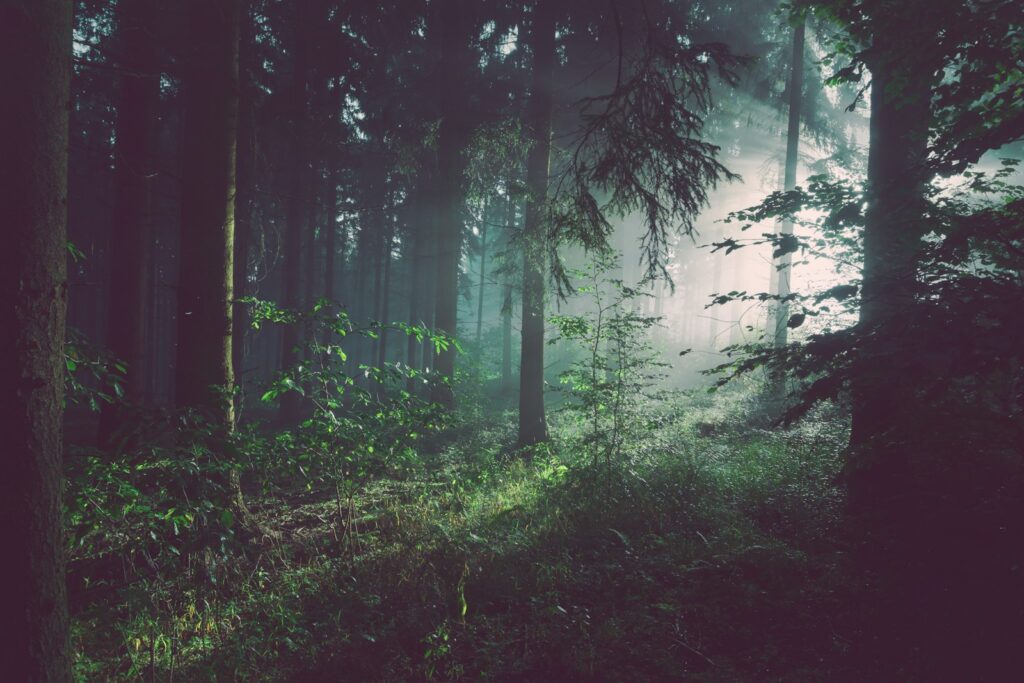
In the forests outside Tver, darkness became part of the legend. During the 1990s, people disappeared after being summoned to quiet meetings, driven beyond the city and taken into isolated woodland. Some bodies were eventually found. Many were not. The forest was more than a hiding place: it became a tool for erasing evidence and magnifying fear.
The men associated with this violence called themselves “forest keepers.” Others gave them a more memorable name: the Wolves of Tver. Their story began in the institutional collapse that followed the end of the Soviet Union, when factories stopped working, police salaries went unpaid and the state’s authority weakened across Russia.
A power vacuum along the road to St. Petersburg
Tver occupied a strategic position on the main highway connecting Moscow with St. Petersburg. Fuel, freight, alcohol and people moved along the route, creating a lucrative stream of money for anyone able to control it. Former athletes, veterans and small-time criminals began organizing around markets, filling stations, transport companies, hotels and roadside businesses.
Protection payments were initially presented as the price of doing business. Refusal, however, could carry a much higher cost. As rival groups competed for territory, extortion became only one part of a wider system that included smuggling, prostitution, weapons and contract violence.
The murder of shadow businessman Yuri Borin in April 1995 signaled that the old underworld was being replaced. He was shot in public with Kalashnikovs, and although the killing remained officially unresolved, its meaning was understood locally: established rules and older power brokers were no longer safe.
The partnership behind the Wolves
Two figures emerged at the center of the new order: Alexander Kostenko and Anatoly Osipov, who became known as “the Wolf.” The pair had met in prison and shared a background in the criminal world. Kostenko was associated with money, corruption and organization. Osipov became the group’s instrument of intimidation and force.
Osipov’s nickname reportedly came from a wolf tattoo on his chest, but the name became more than a personal label. It helped create an identity for a group that wanted to see itself as an elite formation rather than an ordinary street gang. Its members trained regularly, and discipline was treated as a requirement. Drinking on the job was considered weakness; hesitation could end a man’s career—or his life.
That internal culture made the organization unusually dangerous. Violence was not random. It was assigned, managed and repeated by men who understood surveillance, transport and intimidation. The group developed separate roles for couriers, weapons handlers, drivers, informants and gunmen, transforming a loose criminal network into an apparatus.
When a meeting became a death sentence
Many disappearances began with an ordinary invitation. A victim might receive a call or be told that someone wanted to talk at a bathhouse or another private location. The phrase “Ivanich wants to see you,” referring to Kostenko, could be enough to inspire terror.
One case involved Anatoly Leonyev, known as Slonik. He reportedly left his car and entered a vehicle with Osipov and Osipov’s son. Investigators later reconstructed a journey out of the city toward remote woodland. At a stop near Savatievo, a gun was drawn. Leonyev was shot and his body was taken into the forest, where it was intended never to be found.
Other victims were business owners who resisted demands for payment. Some were intercepted outside offices or in parking lots. Survivors described being taken into the woods, tied to trees, beaten and threatened. The calm manner of their captors was as frightening as the violence itself: the men could discuss routine matters while treating brutality as ordinary work.
The crime that silenced a region
The killing of the Bashin family became one of the most shocking episodes attributed to the group. Anatoly Bashin managed a market in Kimry and reportedly refused regular payments. Armed men entered his home at night and opened fire. Bashin, his wife and their children were killed.
The message was unmistakable. The Wolves were not simply punishing an individual debtor; they were demonstrating that resistance could endanger an entire household. Afterward, fewer entrepreneurs were willing to challenge the organization openly. Fear became a form of taxation, collected without a legal invoice and enforced without appeal.
The group’s methods also grew more professional. Stolen vehicles were used for some operations, while other cars were prepared to resemble taxis. Killers altered their appearance with wigs and oversized glasses. In one daytime shooting outside an apartment building, a victim was attacked in front of his girlfriend before the gunmen calmly disappeared into traffic.
A parallel state built on fear
By the end of the 1990s, the Wolves controlled far more than a few streets. Their influence reached filling stations, timber, construction, automobile sales, markets and roadside prostitution. Truck drivers paid for safe passage. Motel owners paid for protection. Small businesses along the Moscow–St. Petersburg highway learned that operating without the group’s approval could be dangerous.
At the same time, contract killing became a business in its own right. Entrepreneurs approached the organization to remove competitors, intimidate partners or settle disputes. An alleged assignment against businessman Yuri Belomesnov ended with him being beaten to death near a garage, after which the scene was staged as a robbery.
This was the central transformation: killing became commercial. It was no longer necessarily personal or impulsive. Orders had prices, the work was divided into stages and the participants understood their roles. The organization’s true currency was not cash alone, but the expectation that anyone could be reached.
The structure begins to crack
Power brought visibility. Too many people vanished, too many vehicles appeared in separate investigations and too many telephone numbers connected apparently unrelated crimes. Police investigators gradually recognized a pattern: these were not isolated acts, but the work of a centrally directed structure.
By 2005, the organization was also becoming dangerous to itself. Members knew too much, controlled too many weapons and increasingly sought independent influence. The relationship between Kostenko and Osipov grew more strained as the latter accumulated control over kidnappings, enforcers and the group’s fearsome reputation.
On November 28, 2005, Osipov was shot dead in a Tver district. No witnesses immediately came forward, and no quick arrests followed. But his death changed the balance. Members hid weapons, abandoned vehicles, discarded phones and left the city. For the first time, the fear that had defined the organization began to turn inward.
Osipov’s son attempted to hold together what remained, but the system was already collapsing. In September 2006, Kostenko and business associate Vladimir Gubenko were attacked in a Toyota Land Cruiser on a country road. Gubenko died at the scene, and Kostenko later succumbed to his wounds.
Trials, prison and the final echoes
After the deaths of the leading figures, arrests spread quickly. Men who had remained silent for years began accusing one another. The same structure that had relied on secrecy and obedience unraveled once its leaders could no longer enforce either.
In 2009, leading members of the group’s fighting unit faced trial and received life sentences. They were sent to some of Russia’s most severe high-security prisons. Officially, the Wolves of Tver had ended.
Yet their name returned in the investigation into the 2002 murder of singer Mikhail Krug. The popular performer was shot inside his home after intruders entered during the night. For years the case remained unresolved. In 2019, investigators brought imprisoned gunman Alexander Ageyev back to the house, where he gave an account linking himself and another alleged attacker to the killing.
According to the reported theory, the operation began as a staged burglary designed to create an opportunity for a protection scheme. The plan collapsed when Krug’s family returned unexpectedly, and gunfire followed. The second alleged attacker later died, leaving investigators with an account shaped by the passage of many years and by the deaths of people who might have challenged it.
What remained after the Wolves
The Wolves of Tver did not build a lasting empire. Their organization depended on secrecy, discipline and the belief that no one could safely resist. Once the state began connecting the disappearances, killings and business interests, that belief weakened. Once the leaders were dead, the network had little ability to survive its own internal rivalries.
Still, the legacy of the group was not erased by convictions. It remained in families without graves, in businesses that had paid to survive and in a city where people learned not to ask too many questions after dark. The most enduring lesson is how quickly organized violence can become a substitute for government when institutions fail—and how difficult it is to restore trust after fear has become the local law.
A detail we should revisit?
Send a correction or attribution concern with the article URL and supporting evidence.
Contact SwiftLocale ↗