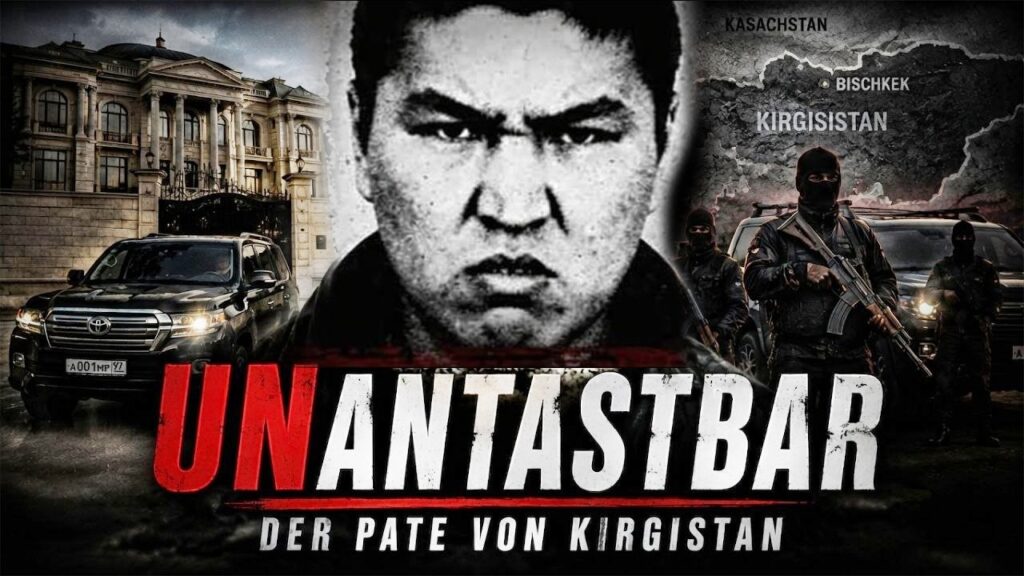
Kamchy Kolbayev’s story is inseparable from the turbulent transformation of Kyrgyzstan after the collapse of the Soviet Union. As the old political and economic order disappeared, criminal networks expanded into the vacuum left by weak institutions. Over the next two decades, Kolbayev moved from the role of a trusted enforcer to the center of a national and regional criminal hierarchy.
A Power Vacuum After the Soviet Collapse
In the early 1990s, Kyrgyzstan gained independence but faced factory closures, mass unemployment, economic uncertainty, and a state apparatus struggling to perform basic functions. The disappearance of familiar rules created opportunities for groups willing to enforce their own order.
One of the most important institutions in the post-Soviet underworld was the status known as “thief in law.” This was not simply a label for an experienced criminal. It represented the highest rank in the criminal hierarchy, traditionally granted through recognition by other senior figures. Those who held it were expected to arbitrate disputes, assign spheres of influence, and command respect across competing groups.
As state control weakened, these figures gained influence beyond prisons and illicit markets. Businesses sought protection, criminal groups sought patrons, and some officials sought alliances. In parts of the former Soviet Union, criminal authority began to overlap with economic and political power.
From Bodyguard to Rival
Kolbayev was born in 1974 in Cholpon-Ata, near Lake Issyk-Kul. His father was a respected coach of Kyrgyz national sports, and Kamchy grew up practicing wrestling in a large family. His physical discipline and social connections later helped him establish credibility in a dangerous environment.
A decisive influence was his older relative Rysbek Akhmatbayev, a prominent underworld figure associated with extortion and control over parts of the shadow economy. Kolbayev initially worked as Akhmatbayev’s driver and bodyguard, learning how power was exercised through personal loyalty, intimidation, money, and connections rather than formal office.
Over time, the younger man built his own network and ambitions. Accounts of the eventual split differ. One frequently repeated version involved suspicions about money from a shared criminal fund and a business registered to Kolbayev’s wife. Other observers regard that dispute as only a pretext for a deeper struggle over succession and influence. The available accounts do not establish every detail conclusively, but the alliance clearly deteriorated into open conflict.
The 2000 Ambush
On June 25, 2000, Akhmatbayev was attacked while traveling through the Boom Gorge between the Chuy and Issyk-Kul regions. Investigators alleged that a Mercedes followed his vehicle through the narrow mountain passage before opening fire. Two of his companions were killed, while Akhmatbayev survived despite severe injuries and reached a hospital under an assumed name.
Akhmatbayev’s refusal to formally cooperate with investigators complicated the case. Even so, Kolbayev and several alleged accomplices were arrested weeks later. A court convicted Kolbayev in connection with the attack and sentenced him to 25 years in prison. He denied responsibility, and the court did not accept the defense. The judgment did not classify the defendants’ temporary association as a bandit group, but it imposed long prison terms for the attack and related offenses.
Prison, however, did not remove Kolbayev from the underworld. It gave him another arena in which to build authority. According to accounts cited in the case narrative, he survived pressure from Akhmatbayev’s loyalists, gathered allies, and became an influential informal leader inside the colony. He was associated with organizing prison life and improving facilities, including a football field and a bath and laundry operation.
An Extraordinary Release
Kolbayev’s sentence was later reduced from 25 to 19 years, followed by further reductions connected to amnesties and official character references. After only a few years, he was transferred to a settlement-style facility near Bishkek. The institution was described as loosely supervised, with no conventional perimeter and many registered prisoners absent from the site.
A subsequent prosecutorial review reportedly found serious violations in the decision to transfer him. By then, Kolbayev had disappeared and left Kyrgyzstan. The circumstances of the reduction and transfer remained a lasting example of the connections and institutional failures that surrounded his rise.
The Struggle for Succession
Akhmatbayev remained an influential fugitive after the 2000 attack, but he was killed outside a mosque in May 2006. A masked gunman reportedly opened fire with a Kalashnikov as Akhmatbayev and his companions approached their vehicle. The murder remained unresolved for years.
In 2023, Kyrgyzstan’s State Committee for National Security presented a new theory, alleging that Kolbayev and several associates organized the killing. That account was based on testimony attributed to a member of Kolbayev’s group, and no independent judicial review of the claim was completed. Several people named in the theory were already dead.
Akhmatbayev’s death triggered a redistribution of power and a series of retaliatory killings. Kolbayev survived a separate 2006 shooting at a Bishkek gas station in which two close associates died. He was wounded but reportedly left the emergency department before security forces arrived. The attack’s organizers were never conclusively established.
With Akhmatbayev gone, Kolbayev negotiated with regional bosses, recruited armed loyalists, and installed trusted overseers. Their reported responsibilities included collecting money, resolving disputes, enforcing discipline, and maintaining influence over businesses and detention facilities.
Recognition as a “Thief in Law”
Control inside Kyrgyzstan was not enough to guarantee recognition across the wider post-Soviet criminal world. In 2008, Kolbayev received the status of “thief in law,” becoming widely described as the first ethnic Kyrgyz to hold it. The ceremony reportedly took place in Moscow and reflected the interests of competing criminal factions seeking influence in Central Asia.
The title did not create his power from nothing. Rather, it formalized authority he had already accumulated through regional alliances, money, loyalists, and violence. Afterward, his organization developed a more structured hierarchy, with different people assigned to coercion, finance, regional control, business pressure, and prison management.
A Network Built on Money and Fear
Authorities later linked Kolbayev’s network to extortion, illegal trade, property disputes, kidnappings, and other serious crimes. Investigators also described connections to illicit commercial routes crossing Central Asia, with the southern city of Osh identified as an important logistical point.
The alleged system relied on more than direct violence. Business owners were reportedly pressured through criminal cases, detention, threats, and demands to transfer companies or property to people associated with the organization. Fear became as important as money or weapons: many entrepreneurs allegedly chose compliance, sale, or departure over confrontation.
By the time of Kolbayev’s death, Kyrgyz authorities estimated that assets connected to him and his associates were worth about $1 billion. The reported holdings included land, apartments, hotels, restaurants, recreation facilities, commercial buildings, vehicles, jewelry, and other property. Investigators alleged that some assets were registered in other people’s names or obtained through pressure and unlawful transfers.
International Pressure and Repeated Legal Setbacks
After a change of power in Kyrgyzstan in 2010, Kolbayev left for the United Arab Emirates. Dubai offered distance from Kyrgyz law enforcement and access to international business networks. Abu Dhabi police arrested him in 2011 with several associates over suspected involvement in a jewelry robbery, but he was later released.
The same year, the United States Treasury placed Kolbayev on its sanctions list and identified him as a Central Asian overseer for the international criminal organization known as the Brothers’ Circle. American authorities associated him with drug trafficking, money laundering, and transnational organized crime.
He returned to Kyrgyz custody in 2012, whether after an Interpol arrest or a voluntary return remains disputed. Prosecutors accused him of forming a criminal organization, robbery, weapons and drug offenses, violence against police, and organizing kidnappings. A 2009 kidnapping case involved three investigators who said masked men abducted, beat, and threatened them in an attempt to halt investigations into Kolbayev’s associates.
Witnesses later withdrew or changed important statements, weakening the prosecution. Kolbayev was convicted in 2013, but his sentence was reduced on appeal, and time already spent in detention soon enabled his release. The outcome reinforced the perception that the state could repeatedly investigate him without keeping him isolated for long.
Internal Discipline and New Rivals
Kolbayev remained visible at public events, family celebrations, sports gatherings, and receptions. At the same time, a new rival emerged: Ulan Toktusunov, known as Sakal, who was recognized as a “thief in law” in Turkey in 2014. The competition between the two camps produced murders, arrests, and a struggle for control.
Kolbayev’s own system also generated conflicts. Regional overseers were accused of abusing their positions, misappropriating communal funds, and mistreating prisoners. One prison boss, known as Duysh, was linked by investigators to extortion and kidnappings. After complaints from prisoners, he was eventually killed in a detention facility in 2022. Authorities suspected that the murder had been organized from outside the prison and later connected it to the wider case against Kolbayev.
These episodes showed the limits of centralized criminal authority. A system built on personal loyalty had to manage ambitious subordinates, competing factions, prison unrest, and the constant risk of betrayal. Kolbayev could punish disobedience, but every act of internal violence also exposed the instability beneath the organization’s apparent order.
The Final Operation
By autumn 2023, Kyrgyzstan’s security leadership had announced a campaign aimed not merely at individual gangs but at the broader system of criminal influence. The investigation into the 2022 detention-facility killing became one of the cases associated with Kolbayev’s final period.
On October 4, 2023, security officers went to a restaurant in central Bishkek after receiving information that Kolbayev was there. The stated objective was to detain him and conduct investigative actions. According to the official account, gunfire broke out when officers entered, Kolbayev offered armed resistance, and the security forces returned fire. He died at the scene at age 49.
Officials later gave differing descriptions of the decision-making surrounding the operation. The head of the security committee said he had personally decided that Kolbayev had to be killed, then clarified that the instruction was to use firearms if the suspect resisted. The president supported the security forces’ account that the death resulted from forced fire during the operation rather than a preplanned killing. Questions about the circumstances remained, but the official version was unchanged: Kolbayev died in an armed confrontation with special forces.
What Remained After Kolbayev
His death was followed by a nationwide crackdown. Authorities announced arrests of alleged associates, weapons discoveries, new criminal cases, and seizures of property. Investigations also extended beyond Kyrgyzstan, including arrests in Kazakhstan of people suspected of extorting Kyrgyz citizens working in Russia.
In 2025, Russian authorities arrested Ulan Barchakev, known as Usun Ulan, whom Kyrgyz investigators described as Kolbayev’s closest and most trusted protector. He was accused of helping collect money, taking over businesses and property, and participating in serious crimes, including a 2019 robbery involving a foreign businessman. He was subsequently extradited to Kyrgyzstan.
As senior associates were arrested, fled, renounced their criminal status, or appeared in court, the network that Kolbayev had built over decades began to fracture. Its collapse illustrates a broader lesson about informal power: institutions can be captured or weakened by personal networks for years, but a hierarchy dependent on one central figure is also vulnerable when that figure disappears.
Kolbayev’s rise was enabled by the disorder of the post-Soviet transition, sustained by money and fear, and protected—according to investigators and a parliamentary commission—by contacts inside state institutions. His downfall demonstrated that even a criminal system that appears permanent can eventually be dismantled when political will, security operations, financial seizures, and legal pressure converge.
A detail we should revisit?
Send a correction or attribution concern with the article URL and supporting evidence.
Contact SwiftLocale ↗