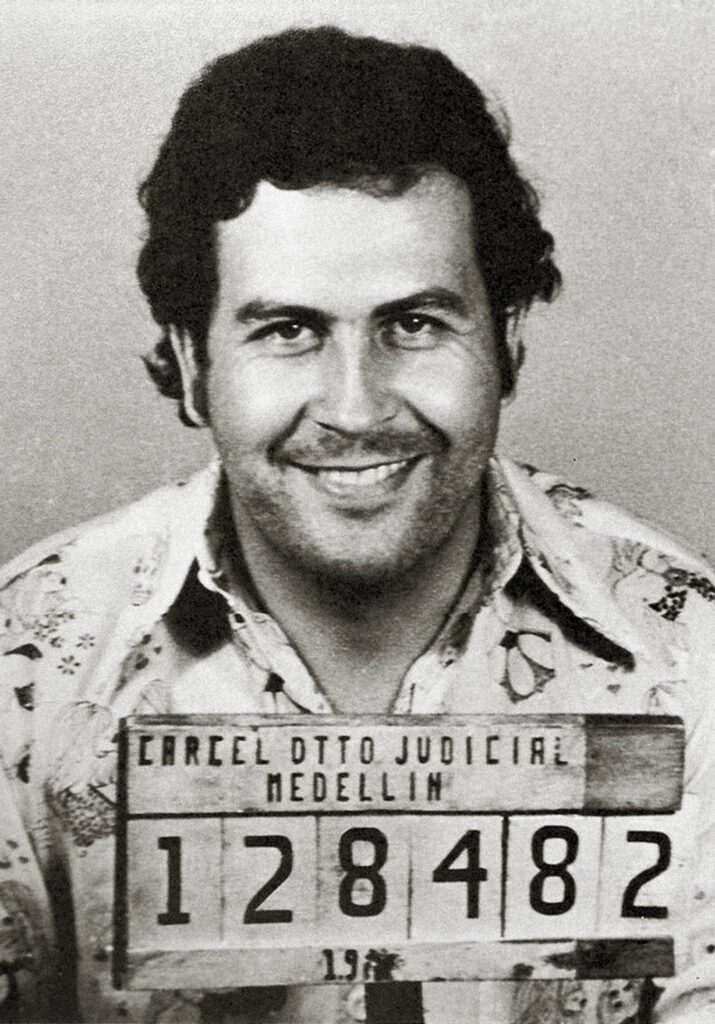
In the early 1990s, Colombia faced a crisis that seemed to place the state itself under siege. Pablo Escobar and the Medellín cartel had accumulated immense wealth through cocaine trafficking, but money was only one part of their power. Their campaign of bombings, assassinations, and intimidation was designed to make the government believe that every attempt to extradite cartel leaders would bring still more bloodshed.
Escobar understood the difference between serving time in Colombia and being sent to the United States. In Colombia, he could influence officials, exploit personal networks, and rely on fear. In an American prison, those advantages would disappear. His response was to wage war against the institutions supporting extradition. Judges, prosecutors, police officers, journalists, and politicians became targets, while ordinary people learned to fear parked cars, anonymous calls, and crowded streets.
A surrender built around one condition
After years of violence, Escobar offered what appeared to be a way out. He would surrender voluntarily, but only if he could determine the conditions of his confinement. Most importantly, he wanted to build the prison himself.
The government accepted the compromise because it promised an immediate reduction in violence. A voluntary surrender could stop attacks, remove the country’s most wanted criminal from the streets, and give the authorities a political victory without another prolonged military campaign. Yet the arrangement contained a dangerous contradiction: the state was treating confinement as a negotiation in which the prisoner could set the essential terms.
The facility, known as La Catedral, was built on a mountaintop near Envigado overlooking the Medellín Valley. Its position offered broad views of the surrounding roads, making it difficult for security forces to approach unnoticed. Officially, it was a high-security prison. In practice, it was designed around the needs of one powerful inmate.
A prison unlike any other
La Catedral bore little resemblance to an ordinary correctional facility. Instead of cramped cells and tightly regulated communal areas, it contained spacious living quarters and amenities associated with a private estate. The grounds included a football field, recreation areas, a bar, a billiards room, a gym, and rooms for receiving visitors.
Escobar was also allowed to remain surrounded by trusted associates. They were classified as prisoners, but their presence gave him a familiar inner circle and preserved the relationships that had sustained his organization. The arrangement was not simply comfortable; it protected the command structure of the Medellín cartel.
The most consequential feature of La Catedral was not its architecture but its weak external oversight. The government maintained responsibility for the outer perimeter, while access and daily activity inside the compound were largely controlled by guards selected for the arrangement. Inspections were infrequent, government representatives could not move freely through the facility, and visits were often coordinated in advance.
That division of authority created an extraordinary situation. The state had built and guarded a prison, yet it had surrendered much of its ability to see what happened inside it.
From confinement to command center
For a short time, the deal seemed successful. Bombings and attacks dropped sharply, and many Colombians felt relief after years of fear. Officials could point to the disappearance of a major criminal from the streets as evidence that negotiation had worked.
But the cartel had not disappeared. Its operations continued through a steady stream of visitors traveling up to the compound. Relatives, lawyers, friends, and supposed guests arrived, but many were reportedly couriers, intermediaries, and trusted representatives. Their visits were not merely social calls. They provided opportunities to discuss money, settle disputes, pass on instructions, and receive reports from the organization outside.
La Catedral had not cut Escobar off from his empire. It had moved the empire’s center of gravity into a place where he was protected from rivals and largely shielded from law enforcement. The prison became a secure headquarters rather than a barrier between a criminal leader and his network.
Reports reaching officials in Bogotá increasingly suggested that the Medellín cartel remained functional. Money continued to move, subordinates continued to follow orders, and there was no clear sign that Escobar’s authority had been broken. The central purpose of imprisonment—removing a dangerous leader’s ability to direct criminal activity—had not been achieved.
Violence inside the walls
The arrangement finally became impossible to defend when a dispute erupted within the cartel. Two influential associates, Fernando Galeano and Gerardo Moncada, were involved in a conflict over money and control. Accounts differ over the precise causes, but the dispute reflected a deeper problem: Escobar’s confinement had not weakened his authority. He still possessed the power to summon senior figures, judge their loyalty, and enforce his rules.
Galeano and Moncada went to La Catedral for what appeared to be an internal meeting. They did not leave. They and several people connected to them were killed inside the compound, reportedly on Escobar’s orders. Their bodies were then moved and efforts were made to conceal the crime.
The killings exposed the true nature of the facility. A prisoner under state protection had allegedly arranged the murder of fellow cartel leaders within the grounds of a government prison. If officials could not prevent such a crime—or even exercise reliable control over the scene—La Catedral could no longer be described as a workable compromise.
The failed transfer
After the murders, the government ordered Escobar’s transfer to a conventional prison. The plan was to move quickly, secure the facility, and place him somewhere he could no longer dictate access or communicate so freely with the outside world.
The operation began in July 1992, but the element of surprise had already been lost. It remains unclear how Escobar learned that authorities were coming. The warning may have come from a leak within government structures or through the network of people who maintained contact with La Catedral. By the time military units reached the compound, Escobar and several close associates were gone.
He is widely believed to have escaped through a prepared route or a vulnerable section of the compound. The details remain disputed, but the broader conclusion is not: the operation failed before the authorities could establish full control of the prison.
The escape was more than a failed transfer. It represented the collapse of the entire strategy behind La Catedral. The state had negotiated with a violent criminal leader, accepted a prison built to his specifications, and permitted conditions that preserved his influence. It had then lost both the prisoner and public confidence.
The meaning of La Catedral
Images of the compound after its capture made the political failure visible. The rooms, recreational facilities, furniture, food, and alcohol looked closer to a private country club or fortified residence than a place where a powerful criminal was serving a sentence.
La Catedral became a lasting case study in the limits of political compromise. Negotiation can save lives in the short term, but a state risks undermining its own authority when the criminal party controls the terms of enforcement. A ceasefire is not the same as the dismantling of a criminal organization, and physical confinement has little meaning if the prisoner can still command people, money, and violence.
The episode also changed Colombia’s approach to cartel leaders. The hope that a special arrangement could permanently neutralize the most dangerous figures gave way to a harder emphasis on removing their ability to influence events. The lesson for corrections officials and organized-crime investigators was equally stark: a prison stops functioning as a prison when its administration loses control of what happens inside.
La Catedral eventually ceased to operate as a prison, and much of the original complex disappeared or changed. Its historical importance, however, does not depend on the surviving buildings. The site represents the moment when a government, desperate to end a war, accepted rules written by the man it was supposed to contain—and discovered that peace without control can become another form of defeat.
A detail we should revisit?
Send a correction or attribution concern with the article URL and supporting evidence.
Contact SwiftLocale ↗